
Photo by Black Taxi Tours of London
Few London institutions embody the city’s intellectual spirit quite like the Athenæum Club, founded in 1824 as a haven for “literary and scientific men and followers of the fine arts.” Its creator, John Wilson Croker, imagined a place where the great thinkers of the age could meet, debate, and exchange ideas beyond the confines of universities and learned societies. The club’s first chairman was the pioneering chemist Sir Humphry Davy, and its first secretary was none other than Michael Faraday, whose experiments would soon reshape modern science.
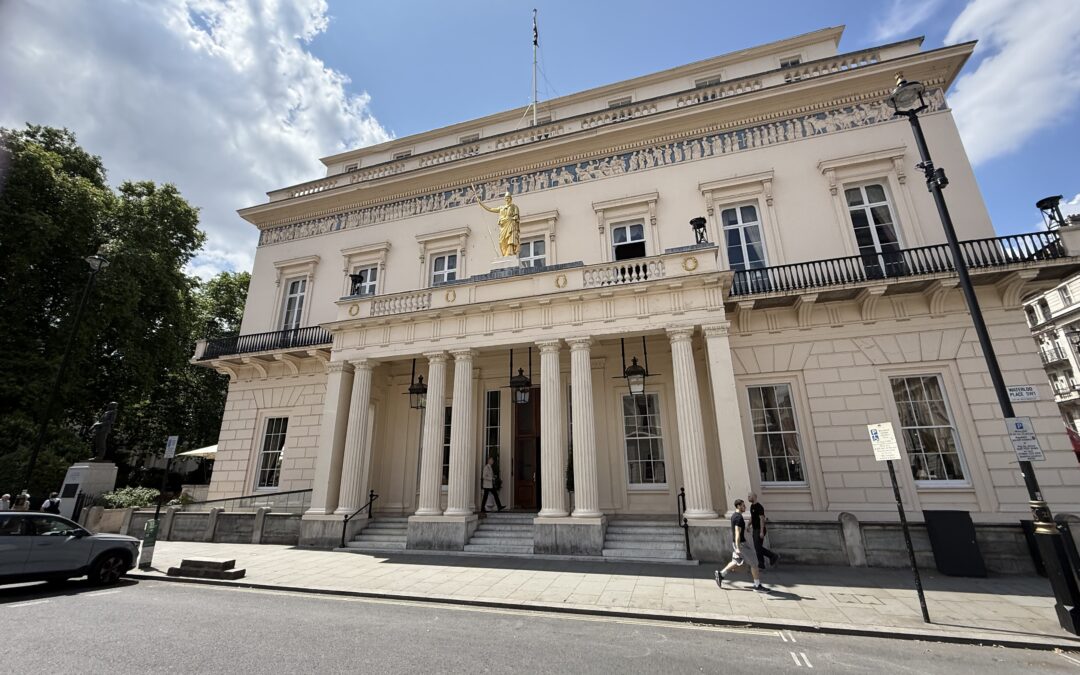
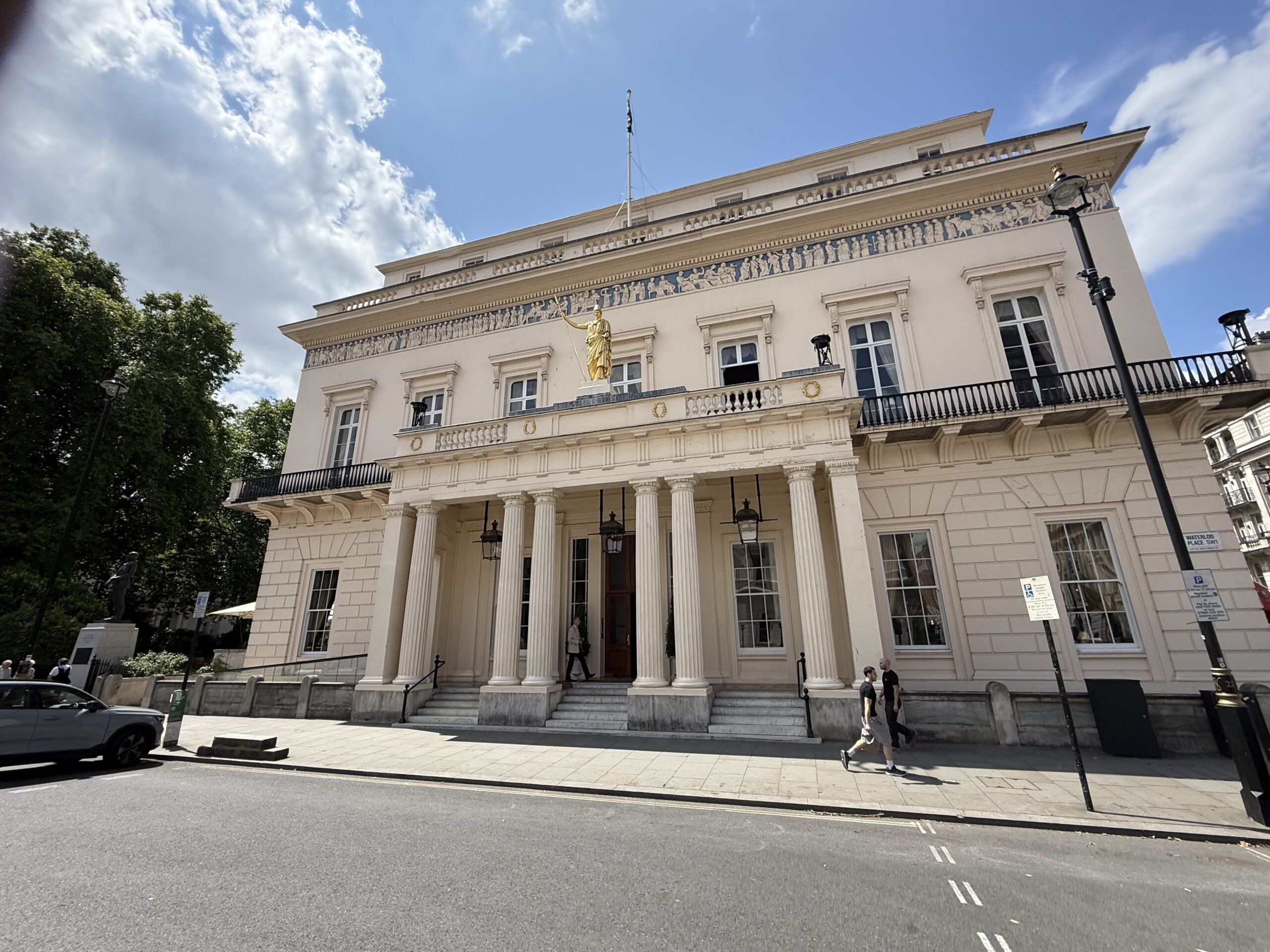
By 1830, the club settled into its permanent home at 107 Pall Mall, a striking neoclassical building designed by Decimus Burton. The façade, complete with a Doric portico and a statue of Athena, the goddess of wisdom, announced the club’s mission before one even stepped inside. Within, members enjoyed a grand library, elegant dining rooms, and quiet spaces for reading and reflection.
The Athenæum’s history is not only one of scholarship and achievement but also of charming eccentricities. One of the club’s most beloved tales involves Charles Dickens, who often slipped into the library to read in peace. On one occasion, staff became alarmed when Dickens seemed to have vanished from the building entirely. After a brief search, he was discovered fast asleep behind a stack of books, so deeply tucked away that even the librarians had missed him. Members joked for years that Dickens could disappear into a novel so completely that he sometimes disappeared from the club itself.
Over the centuries, the Athenæum has welcomed more than 20,000 members, including 51 Nobel laureates, Charles Darwin, T.S. Eliot, Winston Churchill, and Yehudi Menuhin. In 2000, the club opened its membership to women, continuing its tradition of adapting while preserving its core identity: a sanctuary for curiosity, conversation, and the life of the mind.
See the The Athenaeum Club on a black cab tour of London!
www.blacktaxitours.co.uk info@blacktaxitours.co.uk