
Come share in London’s history…
Henry VIII – an unexpected statue
Courtesy of Wikipedia:User:DisillusionedBitterAndKnackered - from english WP, original photo by User:Nevilley replaced by new version from DBaK, CC BY-SA 3.0, https://commons.wikimedia.org/w/index.php?curid=1657384One of my favourite pastimes when driving through...
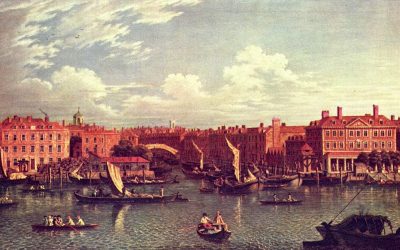
The Fleet River – gone but not forgotten
Image courtesy of Wikipedia. The Fleet River circa 1750. By Samuel Scott 1702-17772To my mind, nothing evokes an image of ‘olde London’ more than the story of its lost rivers. Take the ill-fated Fleet River for example, which flowed from its source in Hampstead,...
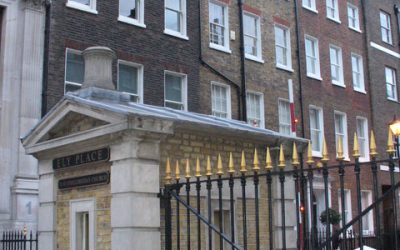
A London street, but is it?
Creative Commons Attribution Share-alike license 2.0. Colin Smith / Ely Place / CC BY-SA 2.0Check out this rather elegant street. Look at the street sign without a London postcode, the private entrance, the beadle on duty. Something strike you as odd? Well it’s one...
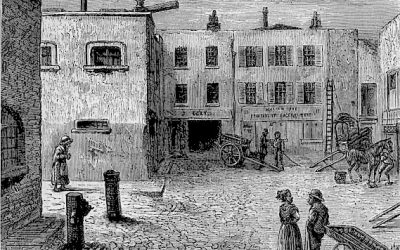
Bleeding Heart Yard – a bloody secret
Image courtesy of Wikipedia. Source: Walter Thornbury and Edward Walford Old and New London. Cassell, Peter & Gaplin, 1873-8, 2.541. This copy taken from Tufts University Archives. [1]Evocative street names abound in London but one that definitely hints at a...
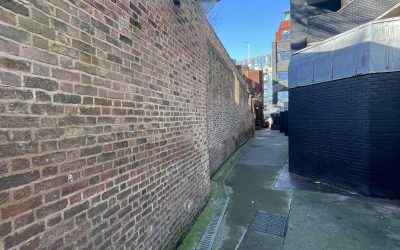
The wall that hides a wretched secret
Take a left off Borough High Street just before Tabard Street, and you’ll find yourself walking down a fairly non-descript alley called Angel Place. On one side is a modern office building and the other a high brick wall. Wait a minute. Look again at that wall. Does...
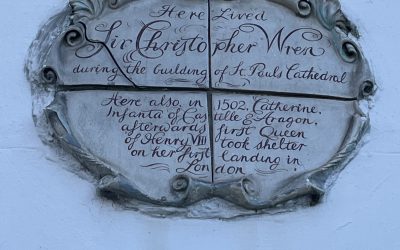
The false historical plaque
One of my favourite stories about the now hugely popular Bankside, concerns the plaque on the wall of a cottage standing virtually alone amongst it’s more prominent and later-built neighbours. The story goes like this. Back in the 1960’s when Bankside was run down and...
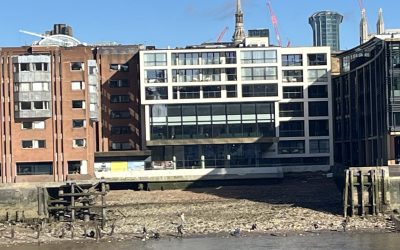
Queenhithe – England’s last remaining Saxon dock
On the north side of the Thames, at low tide, an extraordinary relic of Anglo Saxon London reveals itself. Go back to the 9th century, and London was coming under increasing attack from Viking raids all along the Thames. King Alfred decided to move the Saxon...
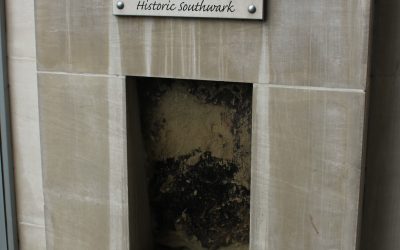
The Ferryman’s seat – Southwark
Before 1750 the only bridge across the Thames was London Bridge (Londoners referred to it as ‘the bridge’) and was so congested, that often the quickest way of getting across the river was by using a waterman or ferryman. Thousands of watermen in skiffs or wherries...
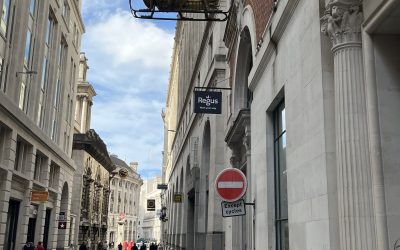
Lombard Street’s hanging signs
In this modern age of the ubiquitous and futuristic glass skyscraper (as exciting as they undoubtedly are) it comes as an amusing surprise to happen on Lombard Street with its historic hanging signs. Explanation? Let’s time-travel back to the 13th century where the...