
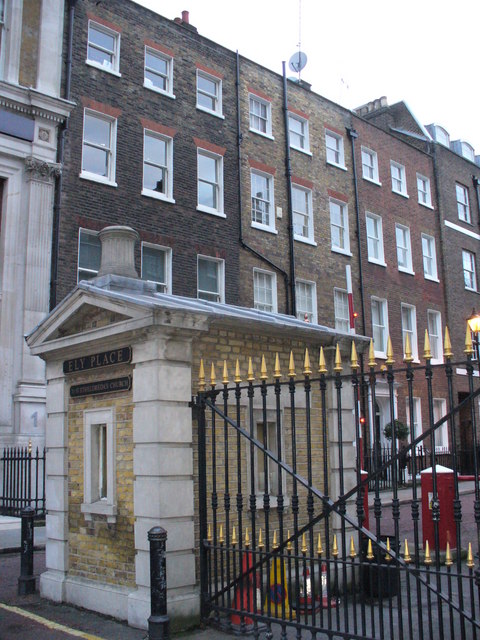
Creative Commons Attribution Share-alike license 2.0. Colin Smith / Ely Place /
Check out this rather elegant street. Look at the street sign without a London postcode, the private entrance, the beadle on duty. Something strike you as odd?
Well it’s one of ‘London’s oddities.’ It wasn’t part of London at all but for hundreds of years, part of Cambridgeshire.
To explain. In 1290, the Bishop of Ely purchased land here and built a grand house for himself. Nothing wrong so far. As a Member of the House of Lords as many bishops were, he spent a lot of time in the capital, so having a London pad seemed perfectly reasonable.
However, here’s where it gets interesting. Being rather an important bishop (or at least he thought so) he was reluctant to subject himself to the laws of the city or more pointedly – the taxes. By establishing a ‘liberty’ or private enclave, he effectively placed this tiny bit of London, into a legal entity of the Diocese of Ely. Sneaky huh?
A grand entrance was erected and a private chapel built, dedicated to St Ethelreda. As this area was not under the jurisdiction of London, thieves and pickpockets on the run could take sanctuary here, undoubtedly causing no end of friction with the local constabulary.
The Bishop’s land stretched well beyond the confines of the current Ely Place and in an attempt or recreate a little bit of Cambridgeshire, orchards and vineyards were planted. Some say the strawberries here were the best in London and it even gets a mention in Shakespeare’s Richard III.
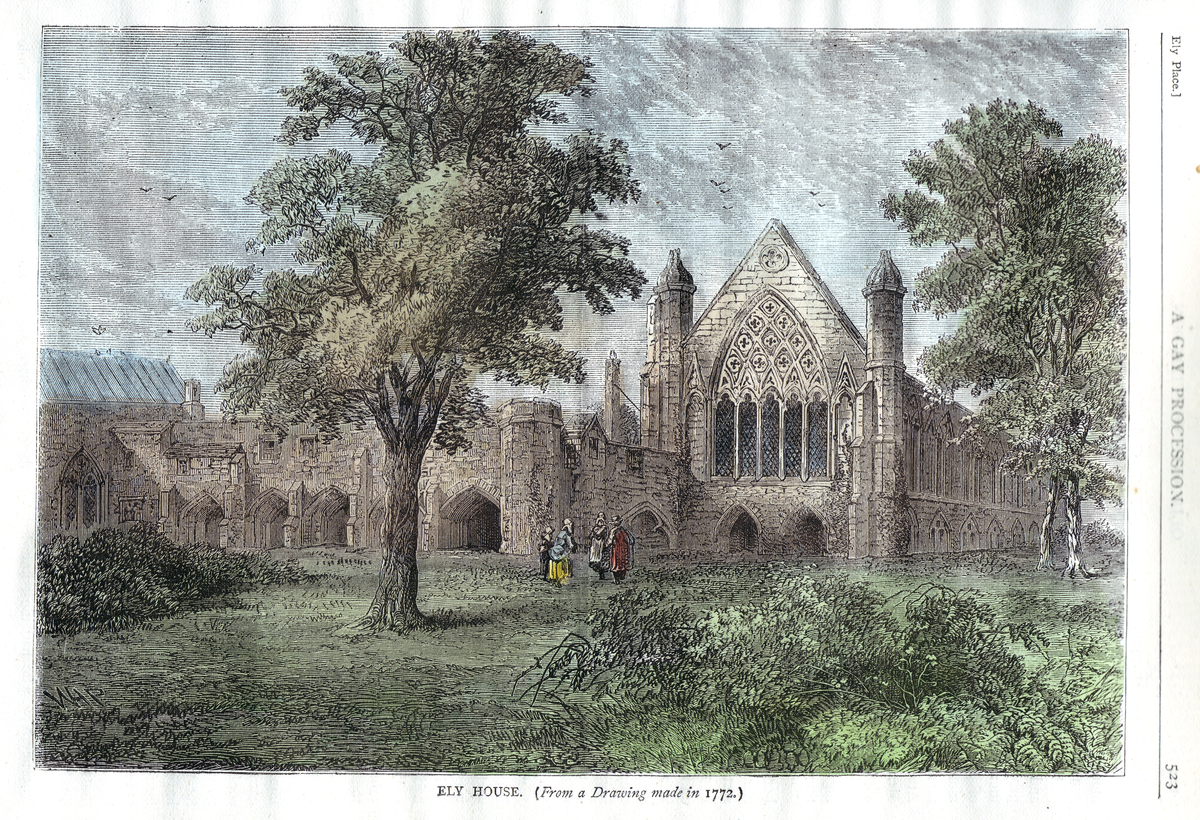
A wood engraving of Ely House in London, including St. Etheldreda’s chapel, the only part of the building still standing. Originally produced by William Henry Prior for the part-work “Old and New London” (1873-1878), based on a 1772 drawing.
A famous resident of Ely Place was Sir Christopher Hatton who wanted to lease and build property here. Nice story this. The Bishop of Ely resisted but didn’t count on Hatton having friends in high places, Queen Elizabeth I no less, who particularly liked the way Hatton danced, forced the bishops to grant Sir Christopher a lease for the payment of one red rose, ten loads of hay (and ten pounds sterling per annum).

No trace of Hatton’s original building remains. When his son (also a Sir Christopher Hatton) got into financial difficulties, he had the mansion and gardens demolished and turned into the streets we see today – including the nearby Hatton Garden, famous for the jewellery trade,
Eventually the whole area was sold to the crown ending centuries of ownership by the Bishops of Ely. However, Ely Place continued to be governed separately by an Act of Parliament in 1842, hence the current entrance and beadles
Just two more secrets before we go. Halfway down a tiny passage between Hatton Garden and Ely Place lies a hidden pub. It’s the Mitre Inn, one of the oldest and smallest pubs in the city, famous for where Sir Christopher Hatton danced with Queen Elizabeth. You can still see part of the cherry tree they danced around.
And for lovers of old churches, the original chapel St Ethelreda, built in the 13th century is still standing, and remains the oldest remaining Catholic Church in the capital.
Courtesy of Wikipedia. Portrait of Sir Christopher Hatton as Lord Chancellor and Knight of the Garter.