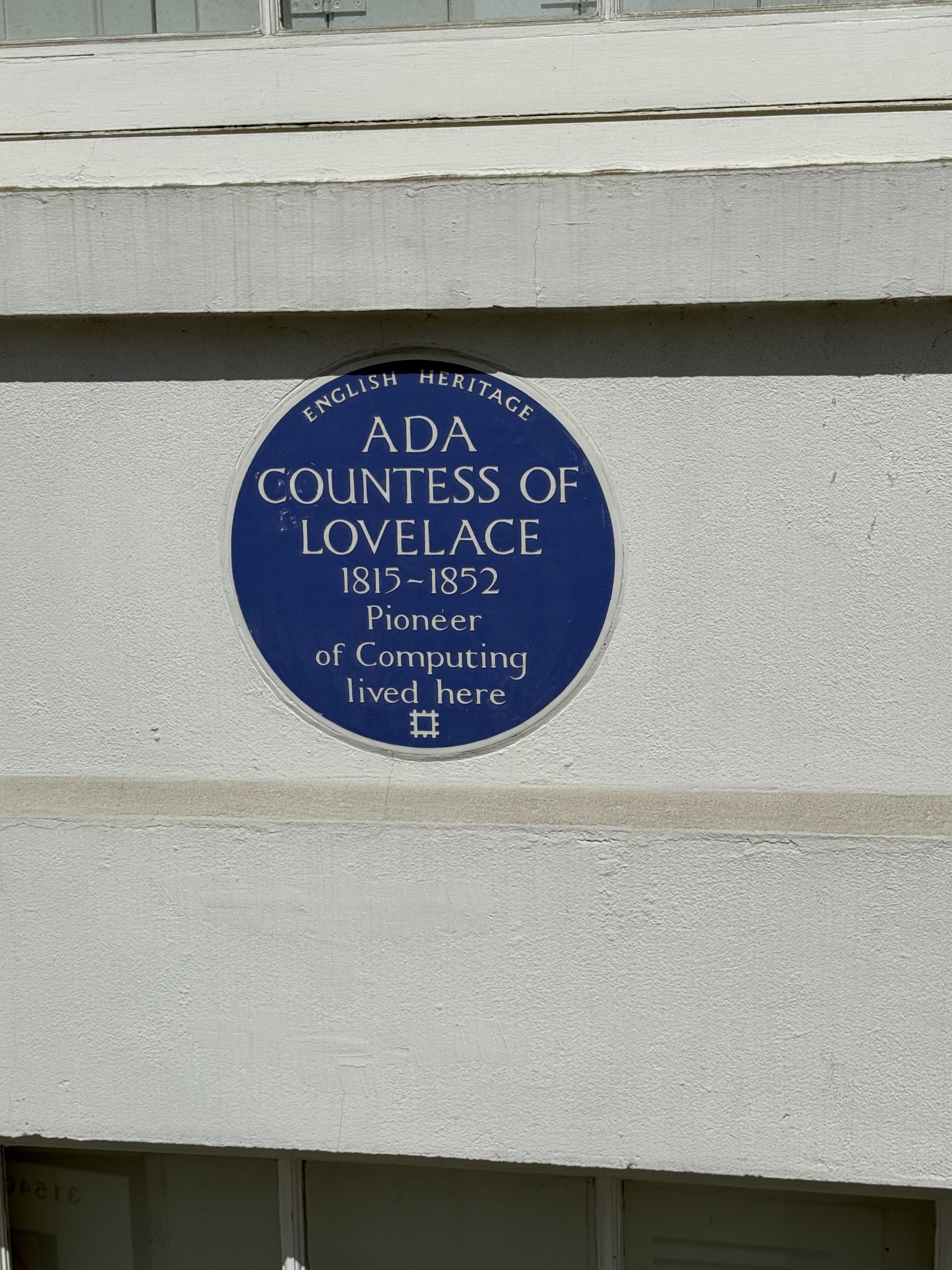
Another beautiful building with a famous past resident.
In the days when virtually all scientists and mathematicians were men, Augusta Ada King, full title Countess of Lovelace (also known as Ada Lovelace) was something of a rarity.
The only legitimate child of the infamous Lord Byron, she was encouraged by Byron to study mathematics and logic because he was terrified she would otherwise inherit his perceived ‘insanity’.
IN 1833, when she was just eighteen, Lovelace’s mathematical talents led her to friendship and long working relationship and with fellow British mathematician Charles Babbage.
Babbage was working on his Analytical Engine at the time which is now generally accepted to be the forerunner of the modern computer. But while Babbage focused on the number crunching attributes of his invention, Lovelace realised that the capability of computers would go far beyond mere calculating and was the first to point out the possibility of encoding information besides mere arithmetical figures, such as music, and manipulating it with such a machine.
So not only was she a brilliant mathematician, she was a visionary as well and fully deserves her blue plaque here in St James’s Square.